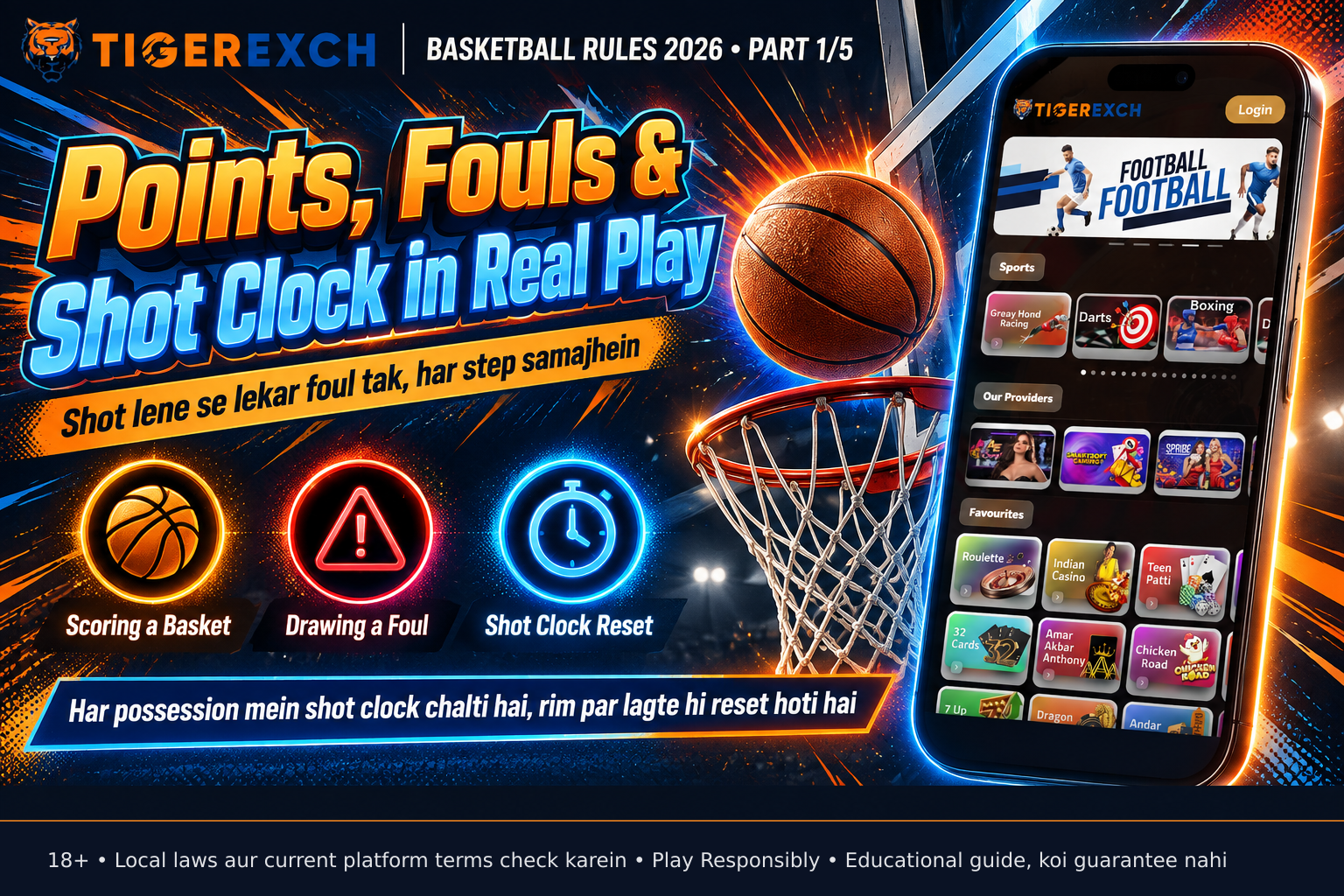
Quick answer: Basketball rules define how points are scored, fouls are called, and the shot clock limits possession time. Scoring: 2 points for shots inside the three-point line, 3 points for shots beyond it, and 1 point for each free throw. Fouls include personal fouls (illegal contact) and technical fouls (unsportsmanlike conduct), with penalties ranging from free throws to possession changes. The shot clock is 24 seconds in both FIBA and NBA, but key differences exist in game duration (FIBA: 4×10 min quarters; NBA: 4×12 min quarters), timeout rules, and defensive three-second violations. This guide explains the core mechanics without promising outcomes or strategies.
Key takeaways:
- Scoring is based on shot location: 2, 3, or 1 point per successful attempt
- Personal fouls result in free throws or possession; technical fouls may lead to ejections
- Shot clock resets to 24 seconds after a shot hits the rim or possession changes
- FIBA games use 10-minute quarters; NBA uses 12-minute quarters
- Defensive three-second rule exists in NBA but not in standard FIBA play
Opening scene: Raat ke 9 baje hain, aapne apne phone pe ek basketball match ka live stream chalaya hai. Court par do teams hain, ball uthane ki awaz sunai de rahi hai, lekin scorecard par numbers samajh nahi aate. Aap sochte hain: "Ye free throw kyun diya gaya? Ye shot clock kab reset hota hai?" Wait — kya aapne rules ka basic idea samjha liya hai? Is guide mein aapko shortcuts ya sure-shot formulae nahi batayenge, lekin scoring, fouls, shot clock aur FIBA vs NBA ke beech ke asli fark samjhaayenge, jis se aap match ko story ki tarah padh sakein.
What it is and why it matters
Basketball ki rules sirf referee ke haath ki signal nahi, balki game ki structure ka foundation hain. Scoring samjhne se aap jaan sakte hain ki team kyun three-point shot try kar rahi hai ya foul karke clock stop karni chahti hai. Fouls samjhne se aap jaan sakte hain ki jab player ko free throw milta hai, toh uska matlab kya hai. Shot clock samjhne se aap jaan sakte hain ki team kyun jaldi shot le rahi hai ya kyon pass karke time guzar rahi hai. FIBA aur NBA ke fark jaanne se aap international matches (jaise Olympics, FIBA World Cup) aur domestic leagues (jaise NBA) ke beech ka context samajh sakte hain. Ismein koi winning formula nahi, bas mechanism ki samajh — jismein aapko pata chalta hai ki probability same rehti hai, chahe quarter 10 minute ka ho ya 12 minute ka.
7 Core Checks: Basketball Rules Mechanism
1. Scoring: How points are added Field goals inside the three-point arc count as 2 points. Shots made from beyond the arc count as 3 points. Each successful free throw awards 1 point. The three-point line distance differs: FIBA uses 6.75 m (22.15 ft) from the basket, while NBA uses 7.24 m (23.75 ft) at the top of the key. This affects shooting strategy but not the point value itself. Example: A player makes a layup inside the arc — score increases by 2. A player steps beyond the line and makes a jump shot — score increases by 3. A player is fouled while shooting and makes one of two free throws — score increases by 1.
2. Personal fouls: Illegal contact and penalties A personal foul occurs when a player makes illegal physical contact with an opponent, such as pushing, holding, or blocking with excessive force. If the foul happens during a shooting attempt, the shooter gets free throws: 2 shots for a two-point attempt, 3 for a three-point attempt. If not in the act of shooting, the ball is awarded to the opposing team for a throw-in, unless the team is in the bonus (see below). Example: A defender grabs the shooter’s arm mid-jump shot — two free throws awarded. A player sets an illegal screen by moving into the defender’s path — possession goes to the other team.
3. Technical fouls: Unsportsmanlike conduct Technical fouls are called for non-contact violations like arguing with referees, taunting, delay of game, or having too many players on the court. The penalty is one free throw for the opposing team, followed by possession of the ball. Two technical fouls result in automatic ejection. Example: A player yells at a referee after a no-call — technical foul, one free throw for the other team. A coach enters the court without permission — technical foul, same penalty.
4. Shot clock: 24-second possession limit The shot clock requires the offensive team to attempt a shot that hits the rim or enters the basket within 24 seconds of gaining possession. If the shot clock expires without a valid shot attempt, it’s a violation and the ball is turned over. The clock resets to 24 seconds when: (a) a shot hits the rim, (b) possession changes due to a steal or defensive rebound, or (c) a foul is called. Example: Team gains possession, shot clock starts at 24. After 18 seconds, they take a shot that misses the rim — clock continues. If they rebound their own miss, clock resets to 24. If the shot hits the rim, clock resets to 24 regardless of who rebounds.
5. Bonus free throws: Team foul accumulation In both FIBA and NBA, once a team commits a certain number of team fouls in a quarter, the opposing team gets free throws on subsequent non-shooting fouls. In FIBA, the bonus starts at 5 team fouls per quarter. In the NBA, it starts at 5 team fouls per quarter, but the "double bonus" (two free throws) begins at 10 team fouls. Offensive fouls do not count toward the team total. Example: Team A has committed 4 fouls in Q2. On the 5th foul (non-shooting), Team B gets two free throws (FIBA) or one free throw plus possession (NBA, before double bonus). On the 10th foul in NBA, Team B gets two free throws.
6. Game duration: Quarter length differences FIBA games consist of four quarters of 10 minutes each (40 minutes total). NBA games consist of four quarters of 12 minutes each (48 minutes total). Overtime periods are 5 minutes in both leagues. This difference affects total possessions, player fatigue, and strategic timeouts but does not alter scoring or foul mechanics. Example: A close game in FIBA may have fewer total shots than an NBA game due to shorter quarters, but each possession still follows the same 24-second shot clock rule.
7. Defensive three-second rule: NBA-only restriction The NBA has a defensive three-second rule: a defender cannot remain in the lane (the painted area under the basket) for more than three consecutive seconds without actively guarding an opponent. Violation results in a technical foul — one free throw for the offense and retention of possession. FIBA does not enforce this rule in standard play (though some variations may use it). Example: A center stands in the lane for 4 seconds while the offense is on the other end — defensive three-second violation, technical foul called. In FIBA, the same positioning would not be a violation unless it involved illegal contact.
Device and Account Security
Agar aap basketball match ko live stream kar rahe hain ya kisi sports betting platform par jaanakar information jama kar rahe hain, toh account security zaroori hai. Hamesha verified web address par HTTPS lagaye khein (padlock icon check karein). 2FA (two-factor authentication) enable karein — password ke alawa OTP ya authenticator app ki zaroorat hoti hai. Kabhi bhi apna OTP, PIN ya password kisi ke saath share na khein. Unverified APKs se bachiye — sirf official app store ya verified website se app download karein. Ye steps aapke data ko transit mein protect karte hain, lekin siteki legitimacy check karne ke liye aapko current platform terms official page par verify karein honge.
Common Mistakes to Avoid
- Assuming all fouls give free throws: Only shooting fouls or bonus situation fouls award free throws; other personal fouls result in throw-ins.
- Thinking shot clock resets on every rebound: It only resets if the shot hits the rim or possession changes — an offensive rebound off a miss that didn’t hit the rim does not reset it.
- Believing FIBA and NBA have identical rules: While core mechanics align, differences in quarter length, timeout rules, and defensive three-seconds affect game flow and strategy.
- Confusing technical fouls with personal fouls: Technical fouls are for conduct, not contact, and carry different penalties (free throw + possession).
- Overestimating the impact of quarter length: Longer quarters mean more possessions, but scoring probability per possession remains governed by the same rules.
Pre-Session Checklist
| Checkpoint | Action | Status |
|---|---|---|
| Device security | Verify HTTPS and 2FA enabled | ☐ |
| Account safety | Confirm no shared OTP/PIN | ☐ |
| App source | Download only from official store/website | ☐ |
| Time awareness | Note quarter length (FIBA/NBA) before watching | ☐ |
| Foul context | Check if foul was shooting or non-shooting | ☐ |
| Shot clock watch | See if shot hit rim before assuming reset | ☐ |
| Bonus awareness | Track team fouls for free throw eligibility | ☐ |
Brand Section
Tigerexchdemo.com provides informational content about sports rules and mechanics. For platform-specific details such as withdrawal processing times, bonus terms, or current promotions, aapko official terms and conditions page par jaana hoga aur unko verify karna hoga. Ye article sirf shikshak viewpoint se likha hai, koi offer ya guarantee nahi.
Call to action: Aapke next basketball match dekhte waqt, 30-second pause liyein aur scorecard, foul count, aur shot clock par ek nazar daalein — kya aab rules ka mechanism samjh mein aaya?
FAQ
Q: How many points is a free throw worth in basketball? A: Each successful free throw is worth 1 point, regardless of whether it was awarded due to a shooting foul, technical foul, or bonus situation. The value does not change based on game context or league.
Q: What happens if the shot clock expires and no shot is taken? A: It results in a shot clock violation, and the offensive team loses possession. The ball is awarded to the opposing team for a throw-in from the sideline.
Q: Do FIBA and NBA use the same three-point line distance? A: No. FIBA uses a three-point line of 6.75 meters (22.15 feet) from the basket, while the NBA uses 7.24 meters (23.75 feet) at the top of the key, with slightly shorter distances in the corners.
Q: Can you get a technical foul for arguing a no-call? A: Yes. Verbally disputing a referee’s decision, using inappropriate language, or showing excessive dissent can result in a technical foul, leading to one free throw for the opposing team and retention of possession.
Q: What counts as a team foul toward the bonus? A: Only defensive and loose-ball fouls count toward the team foul total. Offensive fouls (e.g., charging, illegal screens) do not contribute to the bonus free throw situation.
Q: Is there a defensive three-second rule in FIBA basketball? A: No, the defensive three-second rule is exclusive to the NBA in standard play. FIBA does not penalize defenders for remaining in the lane without actively guarding an opponent, unless the contact constitutes a personal foul.
Q: How long is an overtime period in basketball? A: Overtime periods are 5 minutes long in both FIBA and NBA competitions. If the game remains tied after the first overtime, additional 5-minute periods are played until a winner is determined.
Q: Does hitting the rim reset the shot clock even if the ball goes out of bounds? A: Yes. As long as the shot attempt makes contact with the rim, the shot clock resets to 24 seconds for the team that gains possession, whether it’s the offense or defense.
Q: Why do teams foul intentionally in the last minutes of a game? A: To stop the clock and send the opposing team to the free throw line, hoping they miss one or both shots. This is a strategic use of the rules, not a guaranteed outcome, and depends on free throw shooting percentage.
Q: Can a player be ejected for two technical fouls? A: Yes. Accumulating two technical fouls in a game results in automatic ejection, and the player must leave the court immediately. The opposing team gets one free throw and retains possession after the second technical.
Q: Are the rules different for women’s basketball? A: The core rules (scoring, fouls, shot clock) are the same across men’s and women’s basketball in both FIBA and NBA/WNBA frameworks. Minor variations may exist in ball size or court markings, but scoring and foul mechanics remain consistent.
Q: How do timeouts differ between FIBA and NBA? A: In FIBA, teams get two timeouts in the first half, three in the second half (with only two allowed in the last two minutes of the fourth quarter). In the NBA, teams get seven timeouts per game, with restrictions on usage in the final two minutes.
Q: Does a blocking foul always give free throws? A: Only if the foul occurred during a shooting attempt. If it’s a blocking foul away from the shooter (e.g., on a drive to the basket), it results in a loss of possession unless the team is in the bonus.
Q: What is the penalty for an offensive three-second violation? A: It results in a turnover — the offensive team loses possession, and the defensive team gains the ball for a throw-in. No free throws are awarded.
Short final takeaway
Basketball rules ki samajh se aap match ko sirf scorecard se nahi, balki uski story se dekh sakte hain — scoring ka mechanism, foul ka matlab, shot clock ka rhythm, aur FIBA-NBA ke beech ke sach fark. Isse aap kisi bhi platform par jaankari jama karte waqt informed raho, lekin yad rakhein: 18+, play responsibly, aur koi sure-shot formula nahi hai. Current terms official page par verify karein.
Sources:
- FIBA Official Basketball Rules 2024 (accessed via fiba.basketball, rules section)
- NBA Official Rules 2024-25 (accessed via nba.com, rules section)
- NCAA Men’s and Women’s Basketball Rules 2024-25 (accessed via ncaa.org, for comparative context on foul bonuses)
creative {"series": "TIGEREXCHDEMO GUIDE 2026 • PART 1", "headline": "Basketball Rules Explained: Scoring, Fouls & Shot Clock", "subheadline": "Learn how points are added, fouls penalized, and possession timed — without shortcuts or sure-shot claims.", "cards": [{"title": "Scoring: 2, 3, or 1 point", "text": "Field goals inside arc = 2 pts, beyond = 3 pts, free throw = 1 pt. Line distance differs FIBA vs NBA."}, {"title": "Fouls: Personal vs Technical", "text": "Personal fouls = illegal contact (free throws or possession). Technical fouls = conduct (1 FT + possession)."}, {"title": "Shot Clock: 24-Second Rule", "text": "Must attempt rim-hitting shot within 24 sec. Resets on rim hit, possession change, or foul. Example-based explanation."}, {"title": "FIBA vs NBA: Key Differences", "text": "FIBA: 4×10 min quarters. NBA: 4×12 min quarters + defensive 3-sec rule. Timeout and bonus rules vary."}, {"title": "Play Responsibly", "text": "18+ only. Decide budget before watching. No guaranteed outcomes. Check platform terms for live use."}], "example": "Example: A player makes a layup inside the arc — score increases by 2. A player steps beyond the line and makes a jump shot — score increases by 3.", "warning": "SHORT CUTS ≠ SURE SHOT"}
Note: This draft requires
Related reading
- The NBA Explained for Indian Fans: Conferences, Play-in, Playoffs and IST Schedule 2026 (laser247demo.com)
- Indian Super League Guide 2026: How the Season, Playoffs & Squad Rules Work (laser247demo.com)
- Kabaddi Rules for New Fans 2026: Terms Used by Commentators Explained (laser247demo.com)
- EuroLeague Basketball Explained 2026 (allwhitelabel247.com)
Visit the official Tigerexch247 site: tigerexchange247.co. 18+ only. Please play responsibly.