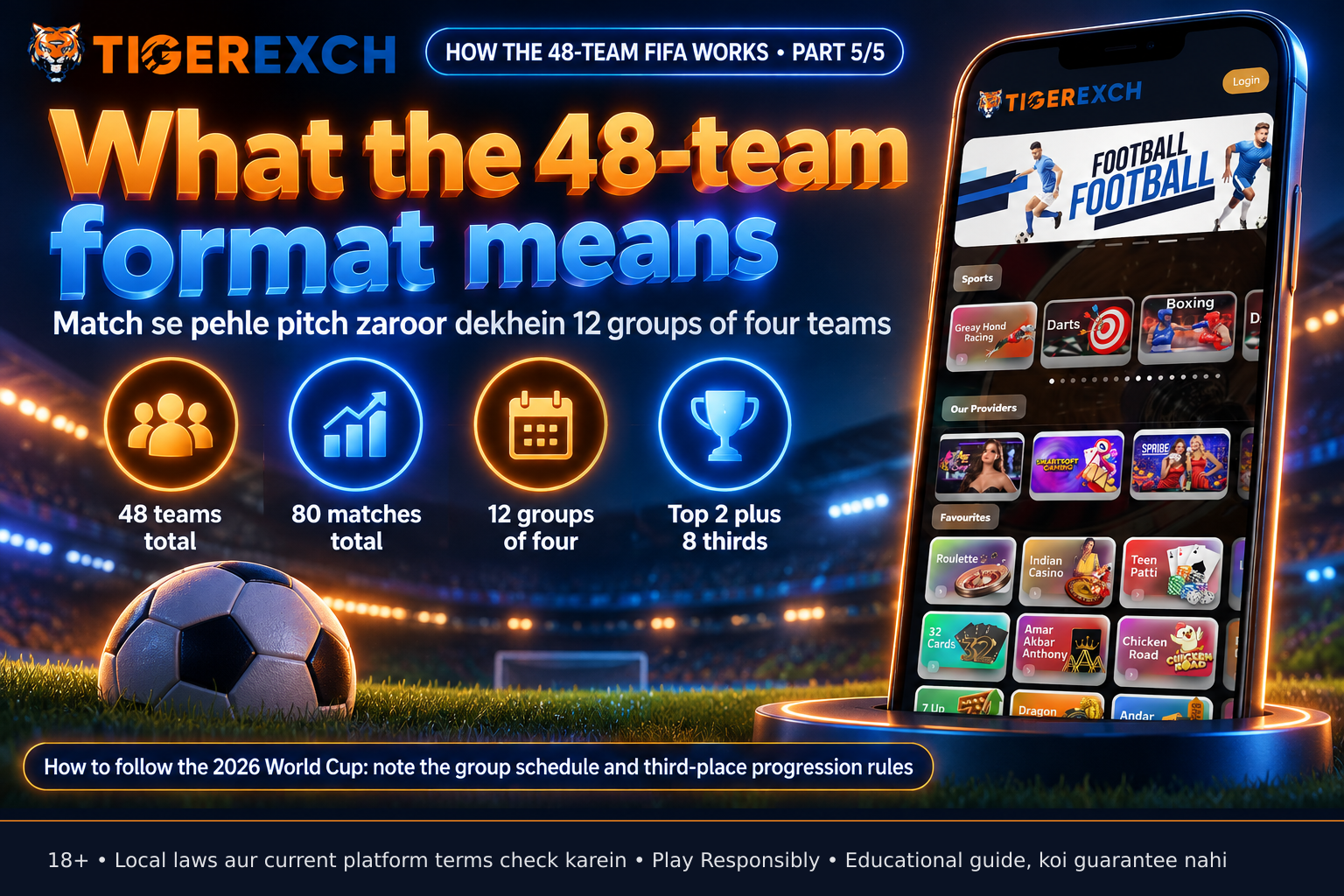
Quick answer: The 2026 FIFA World Cup expands to 48 teams across three group-stage matchdays, with the top two and eight best third-placed sides progressing to a round-of-32 knockout bracket. Slots are redistributed: Asia and Africa gain places, while Europe’s allocation changes only slightly. The format increases total matches from 64 to 80, and the champion will play eight games instead of seven.
Key takeaways – 48 teams split into 12 groups of four; top two plus eight best third-placed sides advance. – Total matches rise to 80; group stage has 48 matches, knockout phase has 32. – Confederation slots: AFC 8, CAF 6, CONMEBOL 6, CONCACAF 6, OFC 1, plus host slots and inter-confederation play-offs. – India’s path runs through AFC qualification and the final play-off round. – The 2026 edition is the first with 48 teams; editions before 2022 had 32.
What it is and why it matters
The FIFA World Cup is football’s global showpiece, held every four years. In 2026, the tournament expands from 32 to 48 teams for the first time. This change affects how groups are formed, how many matches each team plays, and how qualification slots are shared across the six football confederations. For fans in India, it means more matches, more confederations to watch, and a revised path for the national team in Asian qualifying.
The expanded format also changes the knockout structure. Instead of a straight 32-team single-elimination bracket starting at the round of 16, the 2026 tournament uses a round-of-32 bracket after the group stage. This means the total number of matches rises from 64 to 80, and the champion will play eight games instead of seven.
For players and followers on platforms like tigerexchdemo.com, understanding the format helps you follow the competition more closely—knowing when your favoured team plays, how progression works, and why certain matches matter more than others in the group phase.
Confederation slot distribution
FIFA redistributes the 48 slots among the six confederations for the 2026 edition. The table below shows the breakdown, including slots allocated to host nations and inter-confederation play-offs.
| Confederation | Total slots | Breakdown |
|---|---|---|
| AFC (Asia) | 8 | 4 direct + 1 play-off spot |
| CAF (Africa) | 6 | 5 direct + 1 play-off spot |
| CONMEBOL (South America) | 6 | 5 direct + 1 play-off spot |
| CONCACAF (North America/Central America/Caribbean) | 6 | 4 direct + 1 play-off spot + host spot |
| OFC (Oceania) | 1 | 1 play-off spot |
| UEFA (Europe) | 16 | 15 direct + 1 play-off spot |
Host slots: The United States, Canada, and Mexico each qualify automatically as co-hosts, reducing the number of teams needing to earn their place through qualification matches.
The host nations—USA, Canada, and Mexico—take three of the 48 slots automatically. The remaining 45 spots are contested in confederation qualifying tournaments. Asia (AFC) and Africa (CAF) each gain one extra slot compared to the 32-team format, while Europe’s allocation stays at 16. Oceania retains its single slot, which goes to the winner of a play-off against a team from another confederation.
Group stage: 12 groups of four
The 48 teams are drawn into 12 groups, labelled A through L. Each group contains four teams. In the group stage, every team plays three matches—one against each of the other three teams in the same group. This means 48 group-stage matches are played in total (12 groups × 4 matches per group, minus the 12 matches that would be duplicates if every team played every other team; the format uses a single round-robin within each group).
Progression rule: The team that finishes first in each group advances automatically to the round of 32. The team that finishes second in each group also advances. Additionally, the eight best third-placed teams across all 12 groups—regardless of which group they are in—qualify for the round of 32. This means 24 teams progress from the group stage (12 first-place + 12 second-place + 8 third-place), while the remaining 24 are eliminated after three matches.
Tie-breaking: If two or more teams finish on the same number of points, FIFA uses a sequence of tie-breakers: goal difference, goals scored, head-to-head result, goal difference in head-to-head matches, goals scored in head-to-head matches, fair play points (yellow and red cards), and finally a drawing of lots. This sequence is applied within the group and, for third-placed teams, also considers the team’s overall group-stage performance relative to other third-placed sides.
Round of 32 and knockout phase
After the group stage, 24 teams progress to the round of 32. This is a single-elimination knockout bracket. The match pairings are determined by the group-stage results: group winners are matched against the best third-placed teams, and group runners-up face each other or other qualified teams according to a pre-determined schedule.
From the round of 32, the tournament proceeds through the round of 16, quarter-finals, semi-finals, the third-place play-off, and the final. Each knockout match goes to extra time if still level after 90 minutes, followed by a penalty shoot-out if necessary. The total number of knockout matches is 32 (round of 32 + round of 16 + quarter-finals + semi-finals + third-place play-off + final), and with 48 group-stage matches, the tournament produces 80 matches in total.
Also read: 17 June Women’s T20 World Cup 2026: Kaunsi Team Karegi Sabse Bada Dhamaaka?
Qualification slots and India’s path
Qualification is spread across confederation tournaments, which run over roughly two years before the World Cup. Asia’s AFC qualifies four teams directly, with the fifth-best team entering a play-off round. Africa, South America, and North/Central America/Caribbean each have their own qualifying structures. The host nations—USA, Canada, Mexico—qualify automatically.
India’s national team enters the AFC qualification pathway. The format for AFC qualifying involves multiple rounds, starting with a large pool of teams that gradually narrow down. India typically begins in the second or third round of AFC qualifying, depending on the cycle. The goal is to finish in the top four of the final qualifying round to earn a direct spot, or finish fifth to reach the inter-confederation play-off. The exact route depends on the draw and results in the preceding rounds, which are governed by AFC regulations published on the Asian Football Confederation’s official website.
How the mechanism works: a worked example
To understand how progression works, consider a hypothetical group at the 2026 World Cup. Suppose Group A contains Team X, Team Y, Team Z, and Team W. After the three matchdays:
- Team X wins two matches, draws one: 7 points, goal difference +3.
- Team Y wins one, draws two: 5 points, goal difference 0.
- Team Z wins one, loses two: 3 points, goal difference –1.
- Team W loses all three: 0 points, goal difference –2.
In this scenario, Team X finishes first and Team Y finishes second in the group, both advancing automatically. Team Z’s 3 points might be enough for one of the eight best third-placed positions across all groups, depending on results elsewhere. Team W is eliminated after the group stage.
This example is purely illustrative; actual group results will vary. The mechanism—three matches per team, top two plus best third-placed advance—remains the same regardless of which teams are in which group.
Common mistakes to avoid
- Assuming every team plays seven matches. In 2026, the champion plays eight matches (three group games + four knockout games + the final). The extra group match accounts for the eight best third-placed sides.
- Thinking the group winner always faces a third-placed team. The round-of-32 pairings follow a set schedule; some group winners face runners-up, and some face the best third-placed teams.
- Believing a third-place finish guarantees progression. Only the eight best third-placed teams across all groups advance; a team finishing third with few points or a poor goal difference may be eliminated.
- Confusing the knockout bracket with the 32-team format of earlier editions. The 2026 bracket starts at round of 32, not round of 16. The total match count is 80, not 64.
- Checking only the final standings. The tie-breaker sequence matters, especially for third-placed teams fighting for one of the eight qualification spots.
Quick checklist: before you follow the 2026 World Cup
| What to check | Why it matters |
|---|---|
| Which teams are in your favoured group | Determines when your team plays and which progression path they have |
| The group-stage tie-breaker sequence | Explains why teams with the same points may progress or exit |
| India’s AFC qualifying round and position | Shows the national team’s path to the World Cup |
| Which matches are group games vs knockout games | Helps you plan viewing time; group stage has 48 matches, knockout has 32 |
| The host nations’ automatic qualification | Affects the total number of teams and the group composition |
Brand
Tigerexch247 – follow the tournament on our platform for match previews, live scores, and payment guides for UPI and other methods. Check the official platform terms for deposit and withdrawal procedures.
Call to action
Stay updated on every group and knockout match—follow tigerexchdemo.com for the latest fixtures, results, and how-to guides for safe account management.
FAQ
How many teams are in the 2026 FIFA World Cup? The 2026 tournament expands to 48 teams, up from 32 in previous editions.
How many matches will be played in total? 80 matches: 48 in the group stage and 32 in the knockout phase.
How many teams advance from each group? The top two teams from each of the 12 groups advance, plus the eight best third-placed teams across all groups, making 24 teams progress.
What happens if two teams finish the group stage with the same points? FIFA uses a tie-breaker sequence: goal difference, goals scored, head-to-head result, goal difference in head-to-head, goals scored in head-to-head, fair play points, and drawing of lots.
How many third-placed teams advance? Eight teams— the best eight third-placed sides across all 12 groups—progress to the round of 32.
How does India qualify for the 2026 World Cup? India enters the AFC (Asian Football Confederation) qualification pathway. The exact route depends on the qualifying round draw, but the goal is to finish in the top four of the final round for a direct spot, or fifth for an inter-confederation play-off.
Are the host nations USA, Canada, and Mexico guaranteed a place? Yes. As co-hosts, the three nations qualify automatically, taking three of the 48 slots.
What is the round of 32 format? It is the first knockout round after the group stage, where 24 progressed teams are paired in single-elimination matches. Winners advance to the round of 16.
How are the round of 32 pairings determined? The pairings follow a set schedule based on group results: group winners face the best third-placed teams, and group runners-up face other qualified teams according to the tournament bracket.
Can a team finish third in its group and still go home? Yes. Only the eight best third-placed teams across all groups advance. A third-place finish with few points or a poor goal difference may result in elimination.
Where can I check the official qualification schedule? The AFC publishes the qualifying rounds on its official website (the-afc.com). FIFA’s official site (fifa.com) lists the match calendar and slot allocations.
More from Tigerexch247
Related reading
- How the ICC Men’s T20 World Cup 2026 Works (1xbetfair.com)
- How the ICC Men’s T20 World Cup 2026 Works (1xbetfaircustomercare.com)
Visit the official Tigerexch247 site: tigerexchange247.co. 18+ only. Please play responsibly.