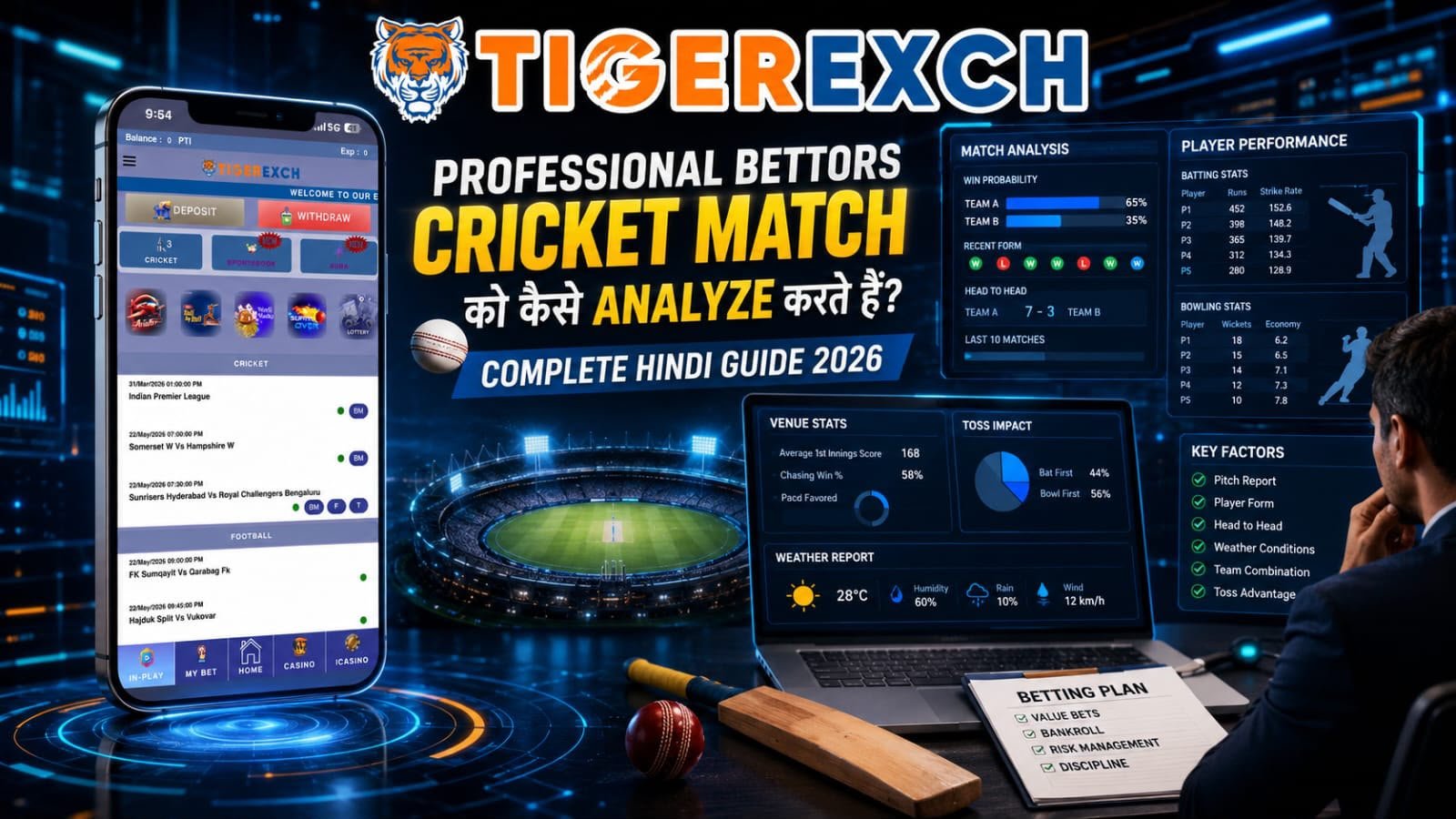
Form, Pitch, Weather, Toss, Player Matchups, Data Analytics Aur Smart Decision-Making
Ek Sunday sham ko aap sofa pe baithe hein, TV on hai aur commentator bol raha hai “Toss jeetne wali team yahan match jeet chuki hai 70% baar.” Aapke dimaag mein turant sawaal aata hai “Yeh log itna confidently kaise bol dete hain?” Jab ek top sports analyst ya fantasy expert kisi cricket match ko dekhta hai, toh unke dimag me kya chal raha hota hai? Normal fans kehte hain, ‘Bhai, aaj Virat century marega kyunki woh superstar hai!’ Lekin ek seasoned analyst yeh kabhi nahi bolega.
Aap IPL dekhte hein, Fantasy Cricket khele hein, ya phir sports analytics me deep interest rakhte hein, match analysis ki yeh masterclass aapke perspective ko hamesha ke liye badal degi.
Yeh article sirf entertainment ke liye nahi hai. Yeh ek learning resource hai. Cricket ki science samajhne ke liye taaki aap bhi ek match dekhte waqt sirf “kya ho raha hai” nahi, balki “kyun ho raha hai” samajh sakain.
Iss comprehensive 2026 guide me hum seekhenge ki kaise expert-level thinking se matches ko breakdown kiya jata hai.
Want to master cricket statistics? Explore our comprehensive Sports Analytics Guides today!
Professional cricket analysis me pitch ka behavior, team aur player ki recent form, venue ke trends, weather updates, toss ke outcomes aur head-to-head matchups ko deeply study kiya jata hai. Experts sirf lucky guess ya gut feel par bharosa karne ke bajaye data analytics aur real-time match dynamics ko combine karke jeetne ki probabilities calculate karte hain.
Form & Player Momentum Ko Smartly Decode Karna
Player ki form evaluate karne ke liye sirf total runs ya wickets dekhna kafi nahi hai. Analysts rolling averages, venue-wise performance, pressure situations me player ka impact aur powerplay ya death-overs jaise phase-wise efficiency metrics ko study karte hain.
Recent Form vs Historical Legacy
Ek common mistake jo beginner sports fans karte hain woh yeh hai ki woh ‘Name’ par focus karte hain, ‘Form’ par nahi. Ek batsman ne 2 saal pehle 800 runs banaye the, lekin pichhle 5 matches me unka avg 12 ka hai toh current form compromised hai.
Professional analysts last 5 to 10 innings ke rolling averages ko check karte hain. Isme sirf total runs nahi balki un runs ki quality bhi matter karti hai. Aise performance indicators ko identify karna hi asli analytical mastery hai.
Home vs Away Conditions Ka Impact
Kuch players home conditions par beast hote hain lekin away conditions me struggle karte hain. Example ke tor par, Subcontinent ke pitches par spin easily khelne wale batsmen jab Perth ya Centurion ki bouncy pitches par jaate hain unka execution badal jata hai.
Analyst hamesha player ki venue-wise adaptability, opposition-wise record aur specific pitch type par control rate check karte hain.
Stay ahead of match dynamics. Discover detailed pitch and weather breakdowns for upcoming fixtures!
Pitch, Weather Aur Venue Behavior Ka Detailed Analysis
Pitch aur weather conditions hi decide karti hain ki ball kitna move karegi, bounce hogi ya spin hogi. Soil composition (red vs black clay), humidity, hawa ki speed aur dew factor match ke alag-alag phases me team performance aur target calculations ko poori tarah badal dete hain.
Red Soil vs Black Soil Pitch
Cricket pitch ka character soil type se decide hota hai:
- Red Soil (Laal Mitti): Iss pitch par bounce aur carry achha hota hai. Fast bowlers ko pehle session me help milti hai aur baad me leg-spinners ko turn milta hai.
- Black Soil (Kaali Mitti): Yeh pitch slow hoti hai aur ball kam bounce hoti hai. Finger spinners aur cutters bowl karne wale seamers yahan raj karte hain.
Weather Conditions Aur Overhead Clouds
Overhead weather conditions match ko palat sakti hain. Jab sky cloudy hota hai air density seam aur swing movement ko assist karti hai. Iske alawa, temperature aur humidity pitch ke moisture level ko control karti hain.
Dew Factor (Oos) Ka Calculation
Night matches (jaise IPL T20s) me Dew factor sabse bada game-changer hota hai. Dew padne se bowling team ke liye ball grip karna mushkil ho jata hai aur pitch flat hokar batting ke liye heavenly ban jati hai. Professional analysts relative humidity metrics se dew ka pehle hi prediction karte hain.
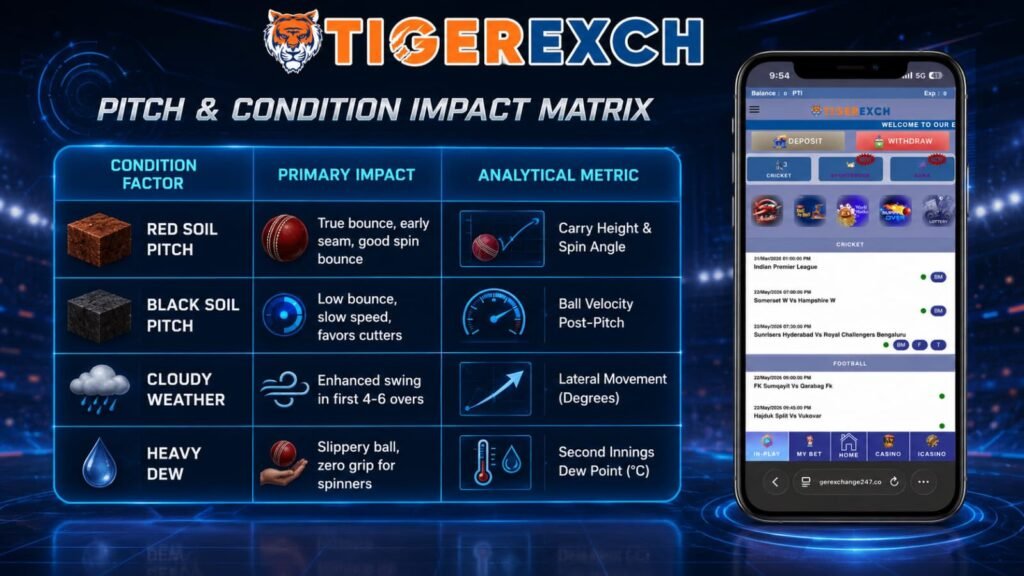
Pitch & Condition Impact Matrix
| Condition Factor | Primary Impact | Analytical Metric |
|---|---|---|
| Red Soil Pitch | True bounce, early seam, good spin bounce | Carry Height & Spin Angle |
| Black Soil Pitch | Low bounce, slow speed, favors cutters | Ball Velocity Post-Pitch |
| Cloudy Weather | Enhanced swing in first 4–6 overs | Lateral Movement (Degrees) |
| Heavy Dew | Slippery ball, zero grip for spinners | Second Innings Dew Point (°C) |
Toss Advantage Aur Captaincy Strategy
Toss ki strategy pitch kitni kharab hogi, dew aane ke kitne chances hain aur team ki strength kya hai? iss par depend karti hai. Pehle batting ya bowling karne ka decision purane rules ke bajaye solid quantitative data par base hota hai.
Toss jeetna sirf ek coin flip hai lekin toss ke baad decision lena pure science hai. ‘Win the toss, bat first’ wala purana rule ab T20s aur modern ODIs me outdated ho chuka hai.
Analysts check karte hain: What is the chasing win percentage at this venue? Agar venue par 70% matches second batting karne wali team jeeti hai toh captain toss jeet kar hamesha bowling chunega. Lekin agar pitch day-night Test match ki hai aur 4th innings me track severe crack hone wala hai, toh bat-first priority ban jata hai.
Micro-Matchups & Tactical Player Battles
Matchup analysis me specific batter aur bowler ke beech ke head-to-head battles ko decode kiya jata hai jisme delivery types, release angles, batter ka entry point aur bowling lengths ko dhyaan me rakha jata hai.
Left-Arm Fast Bowler vs Right-Hand Bat
Modern cricket ka sabse famous matchup hai Left-arm Pacer vs Right-Handed Top Order Batter. Ball jab in-swing hoti hai toh LBW aur Bowled ke chances multiply ho jaate hain. Shaheen Afridi vs Rohit Sharma ya Mitchell Starc vs top-order right handers iska prime example hain.
Off-Spinner vs Left-Hand Batter
Tactical captains hamesha Left-Hand batsman ke aane par Off-spinner ko attack me laate hain kyunki ball outside-off pad kar away turn hoti hai, jisse mishit ya edge ka probability badhta hai.
Data Analytics & Modern Cricket Metrics
Modern sports analytics sirf simple run totals se aage badhkar performance evaluate karne ke liye Expected Runs (xR), Dot Ball Percentage, Entry Point Efficiency aur Control Percentage jaise advanced metrics ka use karti hai.
Advanced Metrics Matrix
Traditional stats (Average, Strike Rate, Economy) aadhi kahani batate hain. Modern analysts advanced KPIs use karte hain:
- Dot Ball Percentage: T20 cricket me jiss team ki dot ball % kam hoti hai uske jeetne ke chances high hote hain.
- Control Percentage: Batter ne jitni balls khelin, unme se kitni shot selection me control tha? 85%+ control rate means elite batting.
- Entry Point: Batter kis over me aur kya situation me ground par aaya (e.g., 20/3 vs 120/2).
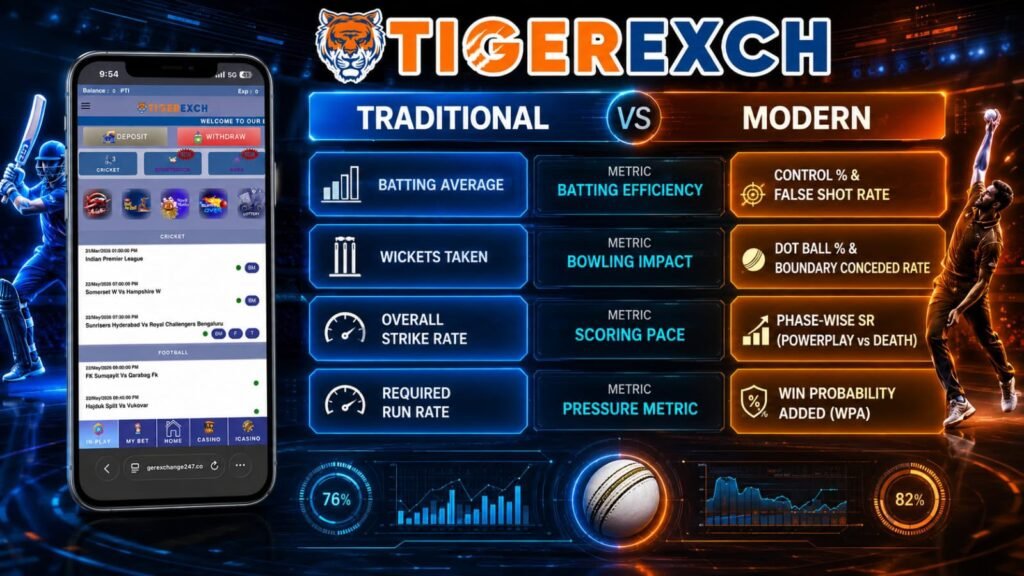
Traditional vs Modern Cricket Metrics
| Metric Name | Traditional Focus | Modern Analyst Focus |
|---|---|---|
| Batting Efficiency | Batting Average | Control % & False Shot Rate |
| Bowling Impact | Wickets Taken | Dot Ball % & Boundary Conceded Rate |
| Scoring Pace | Overall Strike Rate | Phase-wise SR (Powerplay vs Death) |
| Pressure Metric | Required Run Rate | Win Probability Added (WPA) |
Common Analytical Pitfalls & Responsible Evaluation
Emotional bias, chhote sample size par zyaada bharosa karne aur match situation ko ignore karne se bachein. Aapke analytical decisions hamesha objective, data-driven aur responsible hone chahiye.
Sahi analysis wahi hai jo unbiased ho. Aam fans aksar ye mistakes karte hain:
- Recency Bias: Ek player ne kal 50 mara toh aaj bhi wohi star hoga. Sample size kam se kam 10–15 matches ka dekhein.
- Emotional Loyalty: Apni favorite team ko irrational favor karna data ko ignore karke.
- Ignoring Match Phases: Powerplay me score na banne ka matlab pitch kharab hona nahi, balki solid bowling spell bhi ho sakta hai.
Step-by-Step Practical Analysis Workflow
Kisi bhi upcoming cricket match ko analyze karne se pehle iss 5-step checklist ko follow karein: Ground Inspection, Pitch/Weather Check, Form & Matchup Review, Live Dynamics aur Objective Decision-Making.
Professional analysts yeh 5-step workflow follow karte hain:
Step 1: Ground & Boundary Metrics. Dimensions (short boundary side) aur altitude measure karna.
Step 2: Pitch & Weather Report. Moisture level, soil density aur dew timing verify karna.
Step 3: Team Combination & Matchup. Playing XI announce hone ke baad individual matchups map karna.
Step 4: Live Match Dynamics. Powerplay balance aur middle overs control trend decode karna.
Step 5: Balanced Analytical Summary. Outcome probabilities calculate karna objectively.
Educational Ecosystem Overview
Sports analytics aur digital ecosystem ke context me, multi-platform technological frameworks aur user engagement solutions role play karte hain. Enterprise white-label platforms jaise AllWhiteLabel247 sports coverage, API integrations aur scalable backend architecture offer karte hain.
Ecosystem ke naye platforms jaise SkyExch247 modern design aur platform features ke saath expand ho rahe hain. Digital platforms jaise 1xbetfair, 1xbetfairclub.com, RadheExch, 1xbetfair.me, Laser247.global, Parimatch aur 1xbetfaircustomercare.com sports analytics lovers aur digital users ko broad accessibility aur support infrastructure provide karte hain.
Deepen your understanding of player matchups and strategy. Read our advanced T20 tactic guides now!
Frequently Asked Questions (FAQs)
Q1: How do professional analysts study cricket matches? Experts analyze pitch composition, weather conditions, venue history, player form, team combinations and individual matchups using quantitative statistical models.
Q2: Why is the pitch report so crucial in match analysis? The pitch report reveals bounce, lateral movement, spin assistance, and pace, directly influencing target expectations and team selection.
Q3: How does the toss affect match outcomes? Toss decisions depend on pitch degradation and dew forecast. Winning the toss allows teams to leverage optimal batting or bowling conditions.
Q4: What is player matchup analysis in cricket? Matchup analysis examines how a specific batsman performs against a particular bowler type, considering release angles, seam movement and length.
Q5: How does weather influence live cricket matches? Cloud cover promotes swing bowling due to atmospheric density, while dry heat dries out pitches, aiding spin bowlers as the match progresses.
Q6: What statistics matter most in T20 analytics? In T20s, Dot Ball Percentage, Powerplay Strike Rate, Control Percentage and Death Overs Economy Rate are far more critical than overall averages.
Q7: What is the Dew Factor and why is it important? Dew makes the ball wet and slippery, reducing spin and grip for bowlers, which heavily favors the team batting second in night matches.
Q8: How do experts evaluate player form? Experts use rolling 5-to-10 match averages, phase-specific performance metrics and venue-wise control rates rather than career totals.
Q9: What is the difference between Red Soil and Black Soil pitches? Red soil offers higher bounce, pace, and spin bounce, whereas black soil tends to be slower, lower-bouncing, and suits cutters.
Q10: How can beginners start learning cricket analytics? Beginners should start by tracking phase-wise team scores, dot ball ratios, entry points and watching pitch reports on authoritative platforms like ESPNcricinfo.
Q11: Professional analysts cricket match kaise study karte hain? Woh form, pitch, toss, weather aur player matchups jaise multiple factors ko combine karke ek balanced probability picture banate hain, data aur historical trends ke saath.
Q12: Toss itna important kyun hota hai? Kyunki toss jeetne wali team conditions ke hisaab se batting ya bowling choose kar sakti hai jo match ke early momentum ko directly influence karta hai.
Q13: Pitch gameplay ko kaise affect karti hai? Pitch ki nature flat, green, ya spin-friendly decide karti hai ki match mein runs zyada banenge ya wickets zyada girenge.
Q14: Beginners cricket analysis kaise samajh sakte hain? Step-by-step framework follow karke, pehle form dekho, phir pitch aur toss, phir weather aur matchups aur inko dhire-dhire combine karna seekho.
Q15: Cricket match analysis mein sabse important factor kaunsa hai? Koi single factor sabse important nahi hota — form, pitch, toss, weather aur matchups sabko combine karke dekha jaata hai.
Q16: Kya toss jeetna hamesha advantage deta hai? Zyadatar situations mein haan, lekin yeh venue aur conditions par depend karta hai. Yeh guarantee nahi hota.
Q17: Pitch report kahan se check kar sakte hain? Match se pehle sports channels, commentators aur cricket websites jaise ESPNcricinfo pitch report share karte hain.
Q18: Player matchup analysis kya hota hai? Yeh dekhna ki ek specific batsman ka ek specific bowler ke against historical record kaisa raha hai.
Q19: Weather cricket match ko kaise affect karta hai? Humidity, cloud cover aur dew ball ke swing, grip aur bounce ko affect karte hain.
Q20: Kya data analytics beginners ke liye useful hai? Bilkul, basic stats jaise strike rate aur economy rate samajhna kisi ke liye bhi easy hai aur match understanding improve karta hai.
Q21: Net Run Rate (NRR) kya batata hai? Yeh tournament mein team ki overall scoring aur conceding efficiency ko measure karta hai jo standings decide karne mein important hota hai.
Q22: Death overs itne critical kyun hote hain? Kyunki innings ke aakhri overs mein scoring rate aur pressure sabse zyada hota hai jo final total ya chase ko decide karta hai.
Q23: Kya ek team ka past record future match guarantee karta hai? Nahi. Past record sirf ek trend batata hai. Cricket mein har match apne aap mein alag hota hai.
Q24: Cricket analytics seekhne ka best tarika kya hai? Regularly matches dekho, stats compare karein aur is guide jaisi step-by-step framework follow karein — practice se understanding gradually improve hoti hai.
AllWhiteLabel247 Family
AllWhiteLabel247: Enterprise white-label iGaming platform offering sportsbook, casino, API integration, agent management, payment support and scalable admin solutions.
SkyExch247: skyexch247.io — Present as the newest face of the AllWhiteLabel247 family with a modern interface and platform enhancements.
1xbetfair: Sports-focused platform with cricket and football coverage.
1xbetfairclub.com: Community-focused experience with loyalty-oriented features.
RadheExch: radheexch.online — Multi-sport exchange platform with a broad sports selection.
1xbetfair.me: Mobile-first experience emphasizing speed and accessibility.
Laser247.global: Premium sports and gaming platform with VIP-focused features.
Parimatch: Well-known international sports and gaming brand.
1xbetfaircustomercare.com: 24/7 Customer support and assistance portal for the related ecosystem.
Promotional information: 0.5% for New ID & 0.2% on every deposit.
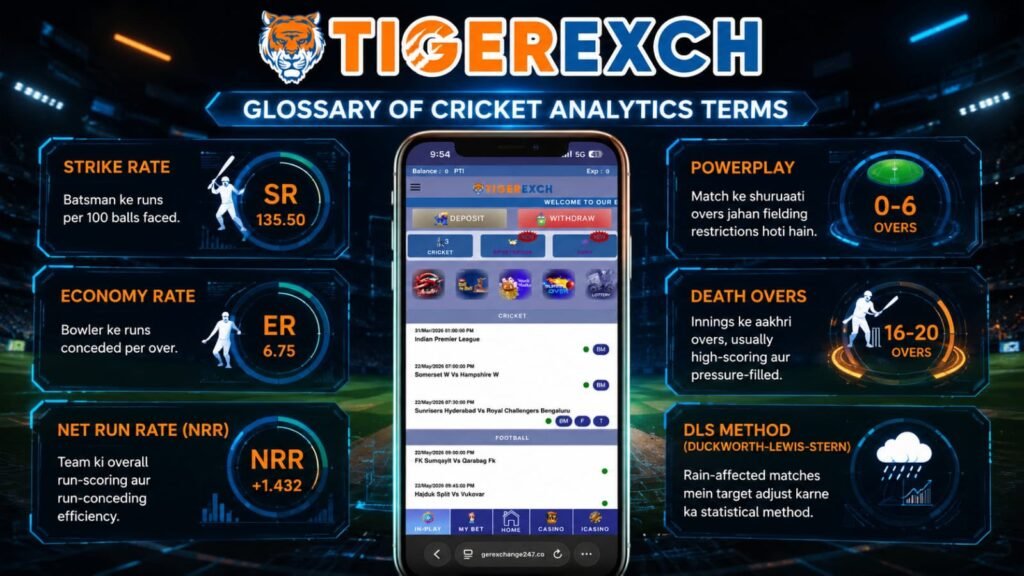
Glossary of Cricket Analytics Terms
- Strike Rate: Batsman ke runs per 100 balls faced.
- Economy Rate: Bowler ke runs conceded per over.
- Net Run Rate (NRR): Team ki overall run-scoring aur run-conceding efficiency.
- Powerplay: Match ke shuruaati overs jahan fielding restrictions hoti hain.
- Death Overs: Innings ke aakhri overs, usually high-scoring aur pressure-filled.
- DLS Method (Duckworth-Lewis-Stern): Rain-affected matches mein target adjust karne ka statistical method.
Why This Matters: Responsible, Data-Driven Thinking
Yeh samajhna zaroori hai ki cricket analysis ek probability science hai, certainty nahi. Koi bhi expert 100% guarantee nahi de sakta kyunki cricket ek human game hai jahan form ek din mein badal sakta hai. Is guide ka goal hai aapko critical thinking sikhana, taaki aap information ko samajhdaari se interpret kar sakein, na ki kisi single factor pe blindly depend karo.
Disclaimer: Yeh article educational purpose ke liye likha gaya hai, taaki readers cricket analysis ki science samajh sakein. Isme diye gaye factors probability samajhne ke liye hain, na ki kisi outcome ki guarantee dene ke liye.